We can do the right thing to create positive change within ourselves and the world around us! I have created this blog with the intention of keeping you informed of news that is affecting humanity and nature throughout the world! There is no better time than the present to become a global participant and not just an innocent bystander. I have provided you with several websites to help empower yourself and a list of global organizations that you can choose from to make a difference.
A powerful FULL MOON in Capricorn on June 28 (5:53 am UT London,12:53 am EST and June 27 at 9:53 pm PDT) puts the emphasis on Career Breakthroughs!
Capricorn rules your public standing, inner authority and divine mission.
You are setting boundaries, accepting responsibilities, organizing and seeking security.
With Saturn (ruler of Capricorn) conjunct the Moon – the emphasis on these qualities is greatly enhanced!
Moon in Capricorn opposite Sun in Cancer are both at 6° – the number of love, compassion, home, family, nurturing, responsibility, home business and abundance.
June 28 reduces to 10 and a 1 – attracting new beginnings. So, even though full moon’s signify a culmination, there’s also a strong sense of, “I am starting fresh today and honoring my feelings every step of the way.”
Several absolutely WONDERFUL transits accompany this full moon:
Moon conjunct Saturn – Saturn rules Capricorn
Moon merged with Saturn during a Capricorn Full Moon is powerful!
Saturn governs time and matter and shows the importance of “timing” and self-control and boundaries. So you're going to feel that… the time has come… for something to end, begin, change, shift or break through – but the time has come for something.
I added the images above to Tania Gabrielle's message I've shared with you in this post. The pictures and gifs that I share sum up my interpretation of the current astrological message.
Set the space for something powerful to happen with your life in the second half of 2018. That could very well require that you set some boundaries.
Saturn also rules work and career, so notice whether the time has come for a shift regarding how you approach your divine mission.
Moon is trine Uranus, Sun is sextile Uranus
Uranus is the planet of excitement, breakthroughs, innovation, discoveries, and progressive, out-of-the-box thinking.
Honor your original ideas, your individual way of doing things.
Uranus is a rebel and likes to upend existing paradigms and traditions.
Progress is inevitable when Uranus is in play.
Neptune forms an exact 150° inconjunct to Venus
This is super creative energy… SO imaginative and spiritual – allowing abundance to flow.
Neptune and Venus invite you to activate your innate creator in a new way, with a deeper connection to Source through an immersion into love and beauty.
Venus square Jupiter
Favors ACTING on something to generate the flow of abundance in your life!
Step into that place where you FEEL abundant. Set your mind on one opportunity, and make it happen – many doors can open now as you welcome the flow for prosperity into your life.
Jupiter trine Neptune
Jupiter trine Neptune defines beautiful unconditional love. It is so joyful, spiritual, and uplifts the soul.
This trine began at the end of May and is one of the defining transits of 2018.
Such fabulous transits happening during this powerful and positive Full Moon in Capricorn! All coincides with June’s powerful 17 universal month of immortality and leaving a legacy behind!
Make the most of the gorgeous energy!
Love and Blessings,
Tania Gabrielle
P.S. For the most in-depth daily astro-numerology forecast (with printable PDF transcript and monthly star code music selections) delivered to you a month in ADVANCE so you can plan ahead with confidence, check out our monthly Premium Wealth Forecast.
June 26, Tehran #Iran
Bazaarians on strike started their demonstration for the third day at Tehran’s Great Bazaar. The protesters ask the open shops on their ways to close them and join the nationwide protest. #IranProtests#FreeIran2018pic.twitter.com/FItZTponl7
June 26 Isfahan #Iran
Fourth day of Tehran Bazaar strike. Protesters Chants:
"Dignified merchants, support us!
"Don't be afraid. We're all together".
Supporters of Iranian resistance will echo this protests in the #FreeIran2018 convention in Paris on June 30.#IranProtestspic.twitter.com/JeF9q4azeB
Protests against rising prices and chaos at foreign exchange rates continued in Tehran on June 26 for the third consecutive day. Protests have also spread to markets in several other Iranian cities, local media reported.
Judiciary officials say “a large number” of demonstrators have been arrested, while Judiciary Chief Ayatollah Sadeq Larijani has threatened that “disrupting economic activities may entail death sentence” for perpetrators.
Protests have reportedly spread far and wide from Tabriz in the north to the markets in Qeshm Island in the Persian Gulf, agency reports from Tehran say.
In Tehran, public transport officials announced the closure of some metro stations near the Grand Bazaar.
Media and officials close to President Hassan Rouhani have accused Iran’s hard-liners of organizing the protests.
The latest wave of protests started on June 24 at Tehran’s cell phone market and continued at the Grand Bazaar on June 25, when protesters closed their shops and marched toward the Iranian Parliament. Police dispersed the demonstrations on both days on Baharestan Square, where the parliament is located.
The streets around the Grand Bazaar were rife with people chanting slogans against fluctuations in the foreign exchange market that soon turned into anti-government political slogans.
“Union leaders had promised that the Tehran bazaar would be open for business this morning after Monday’s protests. But the agency’s reporters have observed that parts of the bazaar remained closed,” the semiofficial Fars news agency reported early on June 26.
According to Fars, “There are crowds chanting terrifying slogans at 15 Khordad Avenue,” where the Grand Bazaar’s main gate is located.
Other reports say that Bein ol-Haramain Bazaar, Tehran’s traditional market for books and stationary, as well as the blacksmiths market and jewellers market, had also joined the protest. Traders were chanting slogans calling on their colleagues to “unite and close the shops,” the reports said.
Videos posted on social media on June 26 showed the bazaar in Kermanshah in western Iran and the jewellers market of Tabriz in the northwest with shuttered shops and traders chanting protest slogans.
In an article on the front page of the hard-line daily newspaper Kayhan, Hossein Shariatmadari, the daily’s editor and the representative of Supreme Leader Ayatollah Ali Khamenei, suggested the government should deploy plain-clothes security agents among the protesters.
Another video posed on social media show demonstrators in Javadieh in downtown Tehran chanting, “Death to the dictator.”
Abdollah Esfandiary, a member of the trustees of Tehran’s Grand Bazaar, told reporters that rising prices and foreign exchange market fluctuations as well as instability with customs have made the continuation of business at the bazaar virtually impossible.
On June 24, the rate of exchange for the U.S. dollar reached a record high of 90,000 rials, with a 10,000 rial hike in just one day.
Demonstrators at the Grand Bazaar on June 26 voiced concerns over the rate of exchange for the U.S. dollar.
Some officials in the Rouhani administration have implicitly accused hard-liners of organizing the protests.
Presidential adviser Hesamoddin Ashna tweeted, “We should hear the voices coming from the streets and markets. Voices from the street reflect the people’s demands, but we should not mistake the dealers and traders’ voice for that of the poor.”
In another development, the Jomhouri Eslami newspaper described the protests as “a conspiracy against the Rouhani administration,” adding, “The conspiracy will not stop here.”
The daily warned, “It would be a mistake on the part of the plotters to think that they would rise to power if the Rouhani administration is toppled.”
The newspaper was apparently alluding to statements by some of Khamenei’s aides who have called for the dismissal of the Rouhani administration.
Yahya Rahim Safavi, an adviser to Khamenei, said on June 24, “Sometimes it seems the country would be better off without an administration.”
Meanwhile, some of the ultra-conservative MPs in the parliament have been taking about tabling a motion to remove Rouhani from his post.
The administration’s spokesman, Mohammad Baqer Nobakht, has said in response to the MPs that, “Some people are planning to create insecurity in the country by portraying the administration as incapable of meeting people’s demands.”
The parliament discussed the “economic chaos” in a closed-door session on June 26, and some MPs described the situation as “the United States’ economic war” against Iran.
Hard-line MP Nader Qazipour said at the session that “those who created this economic situation in Iran should be executed.”
The Chief Justice of Iran Sadegh Larijani has threatened the merchants who have been protesting in Tehran against rising inflation since June 25, 2018, with execution if they don't back down.
"I'm warning you. Listen well. Take the cotton out of your ears and open your eyes. These actions against the country's economic order are punishable by execution-if found to be on the level of 'corruption on earth"-or up to 20 years in prison and the confiscation of all possessions," he said in a speech to judicial officials in Tehran on June 26.
"We will not hesitate to implement the law," he added.
A business owner in Tehran's Grand Bazaar told Center for Human Rights in Iran (CHRI) on June 26 that shutting down his business was not only a sign of "protest against the government's economic policy but also a good business decision."
"We are better off shutting down our stores for a month and coming back with much less loss, rather than selling goods and doing business," said the merchant, referring to the substantial financial losses he would incur if he purchased goods at the current currency rate.
The protests by the merchants, known as bazaaris in Iran, began in Tehran's Grand Bazaar on June 25, 2018, and turned into a mass socioeconomic and political rally outside the Parliament building where police fired tear gas at crowds chanting anti-state slogans.
The demonstrations started after another sharp fall in the value of the Iranian currency, the rial, which in a matter of weeks has lost nearly half its value in the black market. Iranian banks issue a limited amount of dollars, forcing people to obtain currencies on the black market, which trades at a much higher rate.
The official rate set by the Central Bank of Iran is currently about 42,500 rials to the dollar, but the rate on the street was closer to 100,000 rials as of June 25.
The bazaar was closed on June 25 but smaller protests continued the next day in Tehran and around the country including the cities of Isfahan, Arak and Kermanshah on June 26.
"The price of goods is constantly on the rise and merchants can't restock items they have already sold," Ahmad Karimi Isfahani, chairman of the Islamic Society of Merchants, told the state-funded Iranian Labor News Agency (ILNA) on June 25. "The instability has left customers and merchants unsatisfied."
"For 40 years we have not seen this kind of action that would shut down the bazaar, but today it happened and we believe that the only and only reason is mismanagement inside the country," he added.
After closing their shops in Tehran's main bazaar on June 25, the merchants marched from surrounding streets toward Baharestan Sq. in front of the Parliament building chanting "death to the dictator," "death to expensiveness," "death to freeloading thugs," "Iranians! Enough is enough, show your mettle" and "our misery is because of Syria, Palestine... Let go of Syria; think about our situation."
"I don't think economic problems are the only factor for the people's dissatisfaction," said Abdolreza Hashemizaie, a reformist Member of Iran's Parliament (MP), in an interview with ILNA on June 25.
"In fact, people are grappling with political and social concerns and if the authorities don't do anything about them, these economically rooted civil protests will turn into disturbances," he added.
Another reformist MP, Jahanbakhsh Mohebbinia told ILNA on June 25, "Up to now, the people have given the officials opportunities to solve economic problems. I suggest officials do not blame the people's movement on foreign instigations."
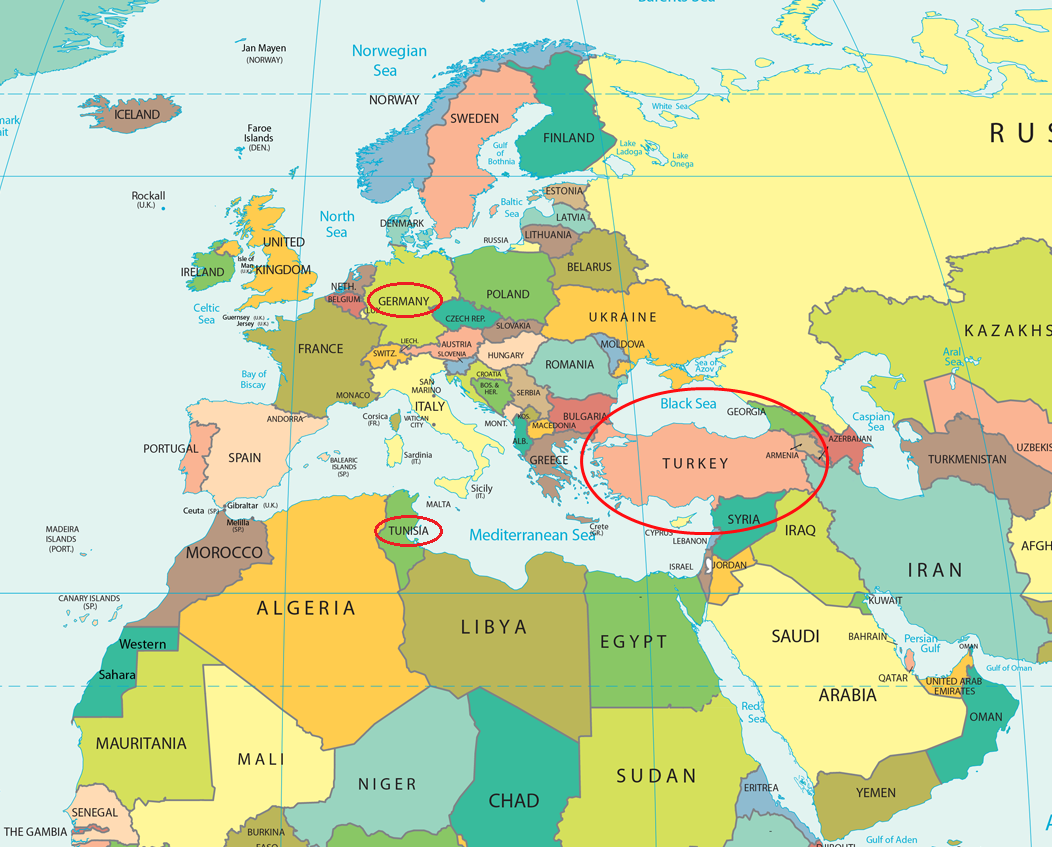
Germany- Tunisian(42) asylum seeker and ISIS member, who helped people join ISIS and was even called a Governor of ISIS in Germany hasn't been deported yet and is fighting it. He claims to be completely reformed and to no longer be a threat.https://t.co/Wup8AClrkbpic.twitter.com/18cFtrNCfn
The Islamic State (ISIS/ISIL) the Left tells us has been made up by Israeli Mossad and US CIA. The Marxist Left and Islamist worldwide adamantly claim ISIS doesn't exist. Welt is a local German news website. I had to use their translation feature. So, the translation will not be perfect. (emphasis mine)
A terrorist helper sentenced to prison is to be deported to Tunisia. But the man refuses to leave Germany. He is no longer dangerous, argues his lawyer.
in a condemned Islamist terrorist helper defends himself in Aachen against his planned deportation. The 42-year-old Tunisian has filed a lawsuit, informed the Administrative Court of Aachen on Tuesday. The city region of Aachen issued an expulsion order because it posed a threat to public order.
His lawyer denies this: The Tunisian is purified and no longer a follower of Islamist ideology. The case is scheduled to be heard by the Administrative Court in the fall. " Aachener Zeitung " and " Aachener Nachrichten " had reported on the case.
The Tunisian was sentenced in June 2016 by the Higher Regional Court of Düsseldorf to five and a half years in prison. He had, according to the verdict, helped with the smuggling of jihadists who wanted to join the terrorist militia Islamic State (IS).
The Tunisian had even been designated by an intermediary of the IS in Turkey as a governor and governor of the militia in Germany. According to Düsseldorf Higher Regional Court, the decision to release him after serving two thirds of his sentence.
After his entry, the 42-year-old had filed an asylum application stating false personal data. After rejecting the application, he had repeatedly been able to prevent his deportation, according to the Administrative Court.
A Tunisian man who was allegedly a bodyguard to late al-Qaida leader Osama bin Laden is to be returned to his homeland, German officials say. He is considered a security threat but had fended off deportation until now.
German officials said on Monday that they had detained a 42-year-old Tunisian man alleged to have served as a bodyguard to the former head of terror group al-Qaida, Osama bin Laden, and were planning to deport him back to his homeland.
His case had caused a public outcry in Germany in recent months when it was reported that the man, identified as Sami A., could not be deported despite being seen as a security threat because a court had ruled that he could face torture in Tunisia.
Change in legal status
Sami A. was detained when he made his mandatory daily check-in at a police station
The move to deport him comes after the Federal Office for Migration reversed the April court ruling
He has lived in Germany for almost two decades without being charged with an offense
Court ruling sets precedent
The ruling by the Constitutional Court in May that another Tunisian man, accused of involvement in the 2015 attack on Tunis' Bardo museum, could be deported to his homeland paved the way for Sami A.'s planned expulsion. Hard-line Interior Minister Horst Seehofer had seized on the May ruling to call on migration authorities to make Sami A.'s case "a priority."
Why was Sami A.'s case so controversial? Many in Germany were outraged that although Sami A. was considered a security threat and had had his application for asylum rejected, he has continued living in Germany. Revelations in the Bild newspaper that he has collected almost €1,200 ($1,400) a month in welfare have compounded their anger.
Why was his deportation previously blocked? In April, a court ruled that deportation was illegal because Sami A. faced "the considerable likelihood" of "torture and inhumane or degrading treatment" if he returned to Tunisia.
What is he suspected of? German justice officials believe Sami A. underwent military training at an al-Qaida military camp in Afghanistan in 1999 and 2000 and that he was among bin Laden's guards, an allegation he has always denied.
Joel Davis, chairman of the International Campaign to Stop Rape and Gender Violence in Conflict, arrested for ‘trying to arrange to rape multiple children as young as two’ https://t.co/LoL3oJU7GO via @MailOnline
The head of a charity that campaigns against sexual violence has been arrested in New York for child pornography and allegedly trying to meet with children as young as two for sex.
Joel Davis, 22, is accused of trying to set up sexual encounters between himself and young children, as well as soliciting an undercover FBI agent to send sexually explicit videos of minors.
The New Yorker was arrested on Tuesday on child sex abuse and child pornography charges.
Davis is the chairman of the International Campaign to Stop Rape and Gender Violence in Conflict - an organization devoted to ending sexual violence.
Prosecutors say despite his involvement in the organization, Davis exchanged text messages with undercover agents over the course of several weeks earlier this month.
Davis allegedly told the agents that he was sexually interested in children of all ages. He is accused of sending the agents sexually explicit photographs of infants and toddlers, including some of the children engaged in sex acts with adults.
The 22-year-old allegedly arranged to meet the nine-year-old daughter of one of the undercover agents and with the purported two-year-old daughter of the officer's girlfriend.
He allegedly went into detail in the text messages about what sexual activities he intended to engage in with the children.
Prosecutors say Davis repeatedly asked the undercover agent to take naked and sexually explicit pictures and videos of the children and to send them to him.
Following his arrest, Davis allegedly admitted to officers that he had abused a 13-year-old boy in the past and that he kept child porn images on his phone.
'Having started an organization that pushed for the end of sexual violence, Davis displayed the highest degree of hypocrisy by his alleged attempts to sexually exploit multiple minors,' FBI Assistant Director-in-Charge William F. Sweeney Jr. said.
'As if this wasn't repulsive enough, Davis allegedly possessed and distributed utterly explicit images of innocent infants and toddlers being sexually abused by adults.'
Davis faced Manhattan federal court on Tuesday charged with enticement of a minor to engage in sexual activity, attempted sexual exploitation of a minor, possession of child pornography and receipt and distribution of child pornography.
According to his LinkedIn profile, Davis has attended Oxford University, Columbia University and The Juilliard School.
US Attorney Geoffrey S. Berman described Davis' alleged actions as 'unfathomable' and 'sickening'.
'Davis started an organization devoted to stopping sexual violence, while allegedly engaged in the duplicitous behavior of sharing explicit images of infants engaged in sexual activity,' he said.
'Davis also allegedly solicited an undercover officer - whom he thought to be a willing participant – to send sexually explicit videos of his nine-year-old daughter, and even to set up a sexual encounter between himself and a two-year-old.
'The conduct alleged against Joel Davis is as unfathomable as it is sickening, and as this case demonstrates, law enforcement will keep its watchful eye on the darkest corners of the internet to bring predators to justice.'
General Studies student Joel Davis was arrested Tuesday in Manhattan on charges of child pornography and attempting to sexually exploit children as young as two years old.
Davis spent years as a sexual assault prevention activist both on and off Columbia’s campus. He was nominated for the Nobel Peace Prize in 2015 for helping to found Youth to End Sexual Violence and serving as the chairman of the International Campaign to Stop Rape and Gender Violence.
After being arrested, Davis allegedly confessed to officers that he had sexually abused a thirteen-year-old boy in the past, and that he kept child pornography on his phone.
Davis was a columnist for Spectator in 2017, writing on topics including being a survivor of sexual assault (like most Spectator columnists, Davis was an outside contributor who was not a member of Spectator’s staff). In a 2014 op-ed in the Huffington Post, Davis condemned the sexual exploitation of children.
Justice Department officials said that over the course of several weeks, Davis exchanged text messages with undercover officers, repeatedly asking that one officer send Davis sexually explicit photos and videos of his nine-year-old daughters.
The Department’s criminal complaint also alleges that Davis described in detail the explicit sexual acts he intended to engage in with both the officer’s nine-year-old daughter and the two-year-old daughter of the officer’s girlfriend.
“Having started an organization that pushed for the end of sexual violence, Davis displayed the highest degree of hypocrisy by his alleged attempts to sexually exploit multiple minors,” Federal Bureau of Investigation Assistant Director-in-Charge William F. Sweeney, Jr. said in a statement.
Davis and the Youth to End Sexual Violence did not immediately respond to Spectator’s requests for comment. He could face up to 70 years in prison.
The Nobel Peace Prize has gone to such names like Martin Luther King, Jr., Nelson Mandela, Mother Teresa, Barack Obama and Kofi Annan. A 2013 Port Charlotte High School graduate could possibly be added to the list.
At 19, Joel Davis has been nominated for the prestigious award.
Davis was recently named to the board of directors for the International Campaign to Stop Rape and Gender Conflict. He was noticed after he started his own group called "Youth to End Sexual Violence."
"I feel like I lead a bit of a double life, college student by day type of thing," Davis said.
As an American University student, he frequently travels from Washington, D.C. to New York to work with the United Nations. He has been to several countries and has even worked alongside well-known activist, Angelina Jolie.
While he is honored by the nomination, he says there is a lot of work to be done.
"It's difficult to me to kind of grapple with that, that on one hand, this is supposed to be our success point, but nothing has really changed. At least not enough for me," Davis said.
Davis' journey began at Port Charlotte High -- where he helped the Model UN team rake in several trophies. His former coach, Robert Johnson, couldn't be more proud.
"Joel has done something that the average person, even from the Model UN has done. So it's very, very rewarding," Johnson said.
Davis says his work with the Model UN in high school showed him world problems he wants to solve, and he hopes he can help inspire Port Charlotte's current students.
"That's a really important program and I would say I hope young people have the opportunity to find something they're passionate about," Davis said.
More than 200 individuals and organizations were nominated this year. It will be awarded in Norway in October.
Police officers gave them flowers, fathers gave their blessing and locals marked the moment with humour as Saudi women took to the streets in their cars after the ban on driving was lifted.
As the clock ticked past midnight on Saturday, a group of women who had been granted licences started their engines, some with fathers or brothers alongside, and others in new cars bought for the occasion. Several women shouted with delight. Others cried, and many more took videos of their first forays at the wheel.
The celebratory mood was mostly confined to pockets of Riyadh and Saudi Arabia’s second city, Jeddah, where the few women who have so far been granted licences were being feted as celebrities. Among them was Fadya Basma, a driver for a ride-sharing company, who is one of the first in Saudi Arabia to legally shepherd men around. “It’s a wonderful day,” she said. “And it will change things. Saudi will never be the same again.”
Samar Almogren, a talkshow host and writer, said: “I always knew this day would come. But it came fast. Sudden. I feel free like a bird.”
Saudi luminaries were quick to herald the moment. Prince Alwaleed bin Talal, , posted a video at 12.01am local time (10.01pm BST) of himself with his daughter Rim at the wheel. “Mummy is not driving a buggy, but a real car,” he said. “Saudi Arabia has finally entered the 21st century.”
Slogans and messages of support were shared on social media. “Today, you take on the streets, tomorrow, Mars,” said one. “This day will be marked in history,” said another. “Drive – we are with you.”
Aware of the potential for the lifting of the ban to shift views about the rigidly conservative state, much of the lead-up has been heavily stage-managed, with lucrative consultancies offered to craft a message of a grateful people offering thanks to Saudi Arabia’s crown prince, Mohammed bin Salman.
Aseel al-Hamad, a Saudi racing driver, has never driven on a track inb her home country, despite being a board member of the country’s motoring foundation. Her debut at the French Grand Prix, where she drove a Formula One car in a parade lap, was promoted by a public relations company, which released a statement in her name.
“I’ve always loved car toys,” it said. “I had the privilege of driving race cars all over the world, but today will be the first in my beloved country. It’s a very special moment.”
Photographs of police officers handing out flowers to female drivers were also carefully choreographed, but across the country, finding a woman behind the wheel during daylight hours was a difficult task. So far, the number of licences handed out has not been publicised. In Jeddah, about 30 women can legally drive. Many thousands more have applied.
Nevertheless, support for the move and a belief that the small advance guard of drivers would soon lead to an influx appeared to be widespread and spontaneous. Ahd Niazy, a writer, said: “This means the world to me, and to the country. This generation changes things.”
Women with international driving licences are thought to be given priority in being approved to drive, along with those deemed not to be involved in activism or seen as unlikely to pose a political risk.
Nour, 24, speaking from a coffee shop in Jeddah’s corniche, said: “All I want to do is take to the roads. As soon as I can, I will. This is a great achievement for all women and it is definitely the key to bigger changes.”
Saudi drivers from ride-sharing companies such as Uber seemed to be less convinced. “I don’t support women driving because I believe they are not the best drivers,” said one. Asked whether his three sisters would soon follow their compatriots’ lead, he said: “I’m not going to allow them and they did not even ask. They have a driver who can take care of everything.”
Any resistance to the move in Saudi Arabia’s deeply conservative society is difficult to gauge. A crackdown on dissent over recent months has left many reluctant to express opinions, especially if they are at odds with official views. Fatima, speaking at a mall in Jeddah, said: “This is not the time to be defying anyone. What I think is not important.”
State media was effusively supportive, with government-run titles lauding newfound independence and potential household savings delivered by reducing a demand for foreign drivers.
Al-Mowaten, a news website, said: “Women being allowed to drive is a necessity more than a luxury. Women will rely on themselves when facing emergencies and difficult circumstances in which they will need to drive and act quickly, especially if a husband or other family member is suddenly stricken with an illness.”
Saudi Arabian women will be able to drive trucks and motorcycles, officials confirm. https://t.co/IKNCBmSTET
Saudi Arabian women will be able to drive trucks and motorcycles, officials have said, three months after the kingdom announced a historic decision to end a ban on women driving.
In September, King Salman issued a decree saying women will be able to drive from next June as part of an ambitious reform push in the conservative kingdom.
The Saudi General Directorate of Traffic gave details of the new regulations that will follow the lifting of the ban on the official Saudi Press Agency late on Friday.
'Yes, we will authorise women to drive motorcycles' as well as trucks, it said, adding that the royal decree stipulates that the law on driving will be 'equal' for both men and women.
There will be no special licence plate numbers for female-driven cars, it said.
But women involved in road accidents or who commit traffic violations will be dealt with at special centres that will be established and run by women.
Saudi Arabia was the only country in the world to impose a ban on women driving and its maintenance was seen around the world as a symbol of repression in the Gulf kingdom.
Its historic decision to allow women to drive from next June has been cheered inside the kingdom and abroad - and comes after decades of resistance from female activists, many of whom were jailed for flouting the ban.
Saudi Arabia has some of the world's tightest restrictions on women.
Under the country's guardianship system, a male family member - normally the father, husband or brother - must grant permission for a woman's study, travel and other activities.
AP ANALYSIS: Saudi (Crown Prince Salman) promise of 'moderate Islam' shifts power.https://t.co/ghvZzzgkJe
DUBAI, United Arab Emirates – The man who may soon be king of Saudi Arabia is charting a new, more modern course for a country so conservative that for decades there were no concerts or film screenings and women who attempted to drive were arrested.
Since catapulting to power with the support of his father, the king, Crown Prince Mohammed bin Salman has pushed forth changes that could usher in a new era for one of the United States' most important allies and swing the kingdom away from decades of ultraconservative dogma and restrictions. He's introduced musical concerts and movies again and is seen as the force behind the king's decision to grant women the right to drive as of next year.
Opposition to the changes has so far been muted, but some critics of the prince have been detained. When social openings in the kingdom were taking place four decades ago, Sunni extremists opposed to the monarchy laid siege to Islam's holiest site in Mecca.
Prince Mohammed's agenda is upending the ruling Al Saud's longstanding alliance with the kingdom's clerical establishment in favor of synchronizing with a more cosmopolitan, global capitalism that appeals to international investors and maybe even non-Muslim tourists.
The prince grabbed headlines in recent days by vowing a return to "moderate Islam." He also suggested that his father's generation had steered the country down a problematic path and that it was time to "get rid of it."
In his sweeping "Vision 2030" plan to wean Saudi Arabia off of its near total dependence on petrodollars, Prince Mohammed laid out a vision for "a tolerant country with Islam as its constitution and moderation as its method."
Prince Mohammed, or MBS as he is widely known, used a rare public appearance on stage at a major investor conference in the capital, Riyadh, this week to drive home that message to a global audience.
"We only want to go back to what we were: Moderate Islam that is open to the world, open to all religions," he said in the ornate grand hall of the Ritz-Carlton. "We will not waste 30 years of our lives in dealing with extremist ideas. We will destroy them today."
His remarks were met with applause and a front-page article in Britain's Guardian Newspaper. In expanded remarks to the paper, the 32-year-old prince said that successive Saudi monarchs "didn't know how to deal with" Iran's 1979 revolution that brought to power a clerical Shiite leadership still in place today.
That same year Saudi rulers weathered a stunning blow: Sunni extremists laid siege to Islam's holiest site in Mecca for 15 days. The attack was carried out by militants opposed to social openings taking place at the time, seeing them as Western and un-Islamic.
Indeed, Sunni extremists have used the intolerant views propagated by the ideology known as Wahhabism to justify violence against others. Wahhabism has governed life in Saudi Arabia since its foundation 85 years ago.
The ruling Al Saud responded to the events of 1979 by empowering the state's ultraconservatives. To hedge the international appeal of Iran's Shiite revolution, the government backed efforts to export the kingdom's foundational Wahhabi ideology abroad. This ultraconservative interpretation of Islam has guided life in Saudi Arabia since its foundation 85 years ago.
To appease a sizeable conservative segment of the population at home, cinemas were shuttered, women were banned from appearing on state television and the religious police were emboldened.
Much is now changing under the crown prince as he consolidates greater powers and prepares to inherit the throne.
There are plans to build a Six Flags theme park and a semi-autonomous Red Sea tourist destination where the strict rules on women's dress will likely not apply. Females have greater access to sports, the powers of the once-feared religious police have been curtailed and restrictions on gender segregation are being eased.
Unlike previous Saudi monarchs, such as King Abdullah who backed gradual and cautious openings, Prince Mohammed is moving quickly.
More than half of Saudi Arabia's 20 million citizens are below the age of 25, meaning millions of young Saudis will be entering the workforce in the coming decade. The government is urgently trying to create more jobs and ward off the kinds of grievances that sparked uprisings in other Arab countries where unemployment is rampant and citizens have little say in government.
The prince has to find solutions now for the problems he is set to inherit as monarch.
"What MBS is doing is a must requirement for any kind of economic reform. Economic reform requires a new Protestant ethic if you will, a new brand of Islam," said Maamoun Fandy, director of the London Global Strategy Institute.
This new Saudi version of "moderate Islam" can be understood as one that is amenable to economic reforms; it does not close shops at prayer time or banish women from public life, Fandy said.
In other words, Saudi Arabia's economic reforms require social reforms to succeed.
Buzz words like "reform," ''transparency" and "accountability" — all used by the prince in his promotion of Vision 2030 — do not, however, mean that Saudi Arabia is moving toward greater liberalism, democracy, pluralism or freedom of speech.
The government does not grant licenses to non-Muslim houses of worship, and limits those of its Shiite Muslim citizens.
The prince has also made no mention of human rights concerns. If anything, dozens of the prince's perceived critics have been detained in a warning to others who dare to speak out.
Some of those arrested were seen as critics of his foreign policies, which include severing ties with Qatar, increasing tensions with Iran and overseeing airstrikes in Yemen that have killed scores of civilians and drawn sharp condemnation from rights groups and some in Washington.
Meanwhile, Prince Mohammed faces a Saudi public that remains religiously conservative. That means he still needs public support from the state's top clerics in order to position his reforms as Islamic and religiously permissible.
These clerics, many of whom had spoken out in the past against women working and driving, appear unwilling or unable to publicly criticize the moves. In this absolute monarchy, the king holds final say on most matters and the public has shown it is welcoming the changes.
___
EDITOR'S NOTE — Aya Batrawy, an Associated Press reporter since 2011, has reported on the Middle East for the past decade and has led AP's coverage of Saudi Arabia since 2013.
"A French woman says she ended up being detained for two weeks in the US after crossing the border from Canada by mistake while jogging on a beach."https://t.co/HvD8U48ycL
— Global Awareness 101 (@Mononoke__Hime) June 24, 2018
Cedella Roman says she did not see any warning signs, and at first did not realise how serious the matter would become.
A French woman says she ended up being detained for two weeks in the US after crossing the border from Canada by mistake while jogging on a beach.
Cedella Roman, 19, ran across the frontier just south of the town of White Rock, British Columbia, into Blaine, Washington state last month.
As the tide started coming in, she went up a path before stopping to take a photo of the picturesque scenery, then turned around to head back.
It was at that moment two US border patrol officers stopped Ms Roman, telling her she had crossed illegally and had been caught on camera.
"I told him I had not done it on purpose, and that I didn't understand what was happening," she explained to the Canadian Broadcasting Corporation.
Ms Roman, who had gone to Canada to visit her mother and practice her English, insisted to the officers she did not see any warning signs, and at first did not realise how serious the matter would become.
"I said to myself, well I may have crossed the border - but they'll probably only give me a fine or they'll tell me to go back to Canada or they'll give me a warning."
But things got more complicated as she was not carrying any government-issued identification on her at the time.
The officers took her to the Tacoma northwest detention centre, run by the Department of Homeland Security, about 190km (120m) to the south.
"They put me in the caged vehicles and brought me into their facility," she said.
"They asked me to remove all my personal belongings with my jewellery, they searched me everywhere.
"Then I understood it was getting very serious, and I started to cry a bit."
When she reached the centre, she contacted her mother, Christiane Ferne, who quickly took her passport and study permits to the facility.
But the staff there said the documents would have to be verified by Canadian authorities.
And she was held at the centre for a fortnight before the matter was resolved and she was allowed to return to Canada.
A spokesperson for the US customs and border protection told CBC that anyone who enters the US outside an official port of entry and without inspection has crossed the border illegally and will be detained.
Amillion Films published on Mar 31, 2015: AmillionGang Films Presents Blood On The Streets The Movie. A street thug who lives by street morals, struggles with turning his life around until he is faced with unfortunate set of events. Please take the time out to Like, Comment, Share and Subscribe. Follow @Bots_Ceo @Bloodonthestreets and like the Facebook Page (Bots The Movie) for more info contact AmillionFIlms@yahoo.com Bloodonthestreets@yahoo.com
Amillion Films published on Dec 25, 2015: BOTSFILM.COM .... AmillionGang Films Presents Blood On The Streets 2 The Movie. A street thug who lives by street morals, Struggles with turning his life around until he is faced with unfortunate set of events. Please take the time out to Like Comment Share and Subscribe.Follow @Bots_Ceo @Bloodonthestreets_ and like the Facebook Page (Bots The Movie) for more info contact Bloodonthestreets@yahoo.com
PLZ LEAVE DONATION AT BOTSFILM.COM FOR BOTS3
Also, Visit our website: BotsFilm.com for Music, Videos, Clothes, Merch and More!
Amillion Films published on Nov 21, 2016: Blood on the Street 3
Contact Info- AmillionFilms@yahoo.com
Bloodonthestreets@yahoo.com
Instagram- Bots_Ceo
Facebook- Ameir White
Amillion Films published on Apr 22, 2016: Music video Threat performed by Mista. Shot by Director Ruth. Blood on the streets movies http://BotsFilm.com
CBC News published on June 20, 2018: Canadian Prime Minister Justin Trudeau said today the Trump administration's policy of separating illegal migrants from their children is 'wrong,' just hours before the U.S. president signalled he's prepared to change course and end the practice.
The U.S. is the focus of international outrage for its policy of separating children from their parents and detaining them after they cross the border in search of asylum.
But Canada has also detained migrant children — and in some cases, has restricted access to their asylum-seeking parents — despite its stated policy to do whatever possible to avoid it.
Last year, 151 minors were detained with their parents in Canadian immigration holding centres.
Eleven others were held in custody unaccompanied by an adult, according to the Canada Border Services Agency. The CBSA would not speculate on the circumstances surrounding why a minor was unaccompanied.
By comparison, the Trump administration has separated more than 2,000 children from their families since instituting a "zero tolerance" crackdown in April on those seeking to enter the United States illegally.
"What's going on in the United States is wrong," said Prime Minister Justin Trudeau on Wednesday. "I cannot imagine what the families are going through. This is not how we do things in Canada."
In Canada, CBSA holds people who are considered a flight risk or a danger to the public, and those whose identity cannot be confirmed.
President Donald Trump signed an executive order on Wednesday afternoon to keep families together at the border, bowing to the intense public pressure surrounding the issue.
'Frightening experience'
The Canadian holding centres, which are off limits to the public, resemble medium-security prisons. They are surrounded by razor-wire fences and kept under surveillance by guards.
There are three such facilities across Canada, in Vancouver, Toronto, and Laval, Que. In some provinces, asylum seekers are detained in prisons.
A recent McGill University study found that detention can be a "frightening experience" for children, leaving them with "psychiatric and academic difficulties long after detention."
Inside, boredom is "pervasive," as children are often left "idle, sleeping or lying on the couches for long periods during the day."
The study examined the experiences of 20 families who were detained in the Toronto and Laval holding centres and found that, in nearly half the cases, children ended up being separated from their parents at some point in the asylum-seeking process.
In detention, mothers are normally permitted to stay with their children. Fathers, on the other hand, are kept separate and only allowed to visit their spouse and children twice a day for about 15 to 30 minutes, according to the study.
In some cases, detained asylum seekers have lived in the country without status for years. In detention, they are given the option of keeping their Canadian-born children with them or sending them to live with extended family or in the custody of provincial youth protection services.
The minors detained last year spent an average of 13 days in custody, but the time period can vary significantly.
The study recounts how, in one instance, a six-year-old girl detained for more than six months asked her parents, "Are they gonna keep us here permanently?"
Aim to keep families together
Public Safety Minister Ralph Goodale said earlier this week that children of immigrants and refugees are detained in Canada only as a last resort.
"Obviously, anyone looking at the human images [from the U.S.] would be very, very concerned," Goodale said.
"Children are very precious creatures, and we all, I'm sure, need to have their safety, their security, their well-being first and foremost in our minds, and that is what lies at the very basis of Canadian policy."
Last November, Goodale issued a directive to CBSA to keep children out of detention and keep families together "as much as humanly possible."
The number of children in detention has dropped slightly under the Liberal government, though it's on pace to rise again this year.
Jenny Jeanes, a co-ordinator with the refugee advocacy group Action Réfugiés Montréal, said she still regularly sees children at the Laval detention centre she visits once a week.
"I'm not sure how well the directive is being applied in some cases," she said.
Scott Bardsley, a spokesperson for Minister of Public Safety Ralph Goodale, said in a statement Wednesday that the CBSA will announce alternatives to detention, such as community supervision, in the coming weeks.
'They have to show up'
Chantal Ianniciello, a Montreal immigration lawyer who represents clients in detention, said families would be better served by the regular process for asylum seekers, rather than being stuck in detention while they get the necessary documentation to identify themselves.
"The way I see it is that those people have an interest in going to court," she said. "If they want to get status and get anything out of the system, they have to show up."
Another study, produced last year by the International Human Rights Program at the University of Toronto's faculty of law, called on the government to find better alternatives to detention, including community housing.
Denise Otis, a protection officer in the United Nations Refugee Agency, said she's hopeful the Canadian government will work toward that goal.
"We imagine [the government] could find other ways to house them while they are trying to identify themselves."
I just want to point out that I always hear the Left blame Americans drug addiction for the influx of drugs pouring into the US from latin American nations. Then spend tons of money on Stop Smoking PSA campaigns and lawsuits blaming the BIG Tobacco Industry for the addiction and deaths caused by using tobacco products. So, which is it? (emphasis mine)
"A judge in Atlanta sentenced a former Texas high school football player who rose through a bloody power struggle for control of a Mexican drug cartel to serve nearly 50 years in federal prison."
ATLANTA - A judge in Atlanta on Monday sentenced a former Texas high school football player who rose through a bloody power struggle for control of a Mexican drug cartel to serve nearly 50 years in federal prison.
Edgar Valdez Villarreal, also known as "La Barbie" for his light eyes and complexion, also was ordered to forfeit $192 million.
Valdez, 44, was accused of bringing trucks full of cocaine from Mexico to the eastern United States and shipping millions of dollars in cash back to Mexico.
He was arrested in Mexico in 2010 and was among 13 people extradited to the U.S. from Mexico in September 2015 to face charges. He pleaded guilty in January 2016 to charges of conspiring to import and distribute cocaine, and conspiring to launder money.
Valdez was born in Laredo, Texas, on the Mexican border. His father was a nightclub and bar owner, and they lived in a middle-class subdivision populated by border patrol agents, police officers and firefighters.
He became a street dealer as a teen when he was still a linebacker on the football team at Laredo United High School, and then climbed the ranks to become a high-ranking member of the Beltran Leyva gang during the era when the gang's leaders were associated with Joaquin "El Chapo" Guzman and the Sinaloa Cartel, prosecutors have said.
He lived a flashy lifestyle, dressing in nice suits and going to clubs, and owning homes in the most expensive parts of Mexico City. But his luxurious life was threatened after Mexican marines killed its leader, Arturo Beltran Leyva, during a gun battle in Cuernavaca in December 2009.
Valdez and Beltran Leyva's brother, Hector, began a bloody fight for control that left dismembered and decapitated bodies in the streets and often hanging from bridges in Cuernavaca and Acapulco, along with threatening messages.
An elite U.S.-trained Mexican federal police squad acting on tips arrested Valdez and four others at a woody vacation home outside Mexico City in August 2010. At the time, then-Mexican President Felipe Calderon called Valdez "one of the most-wanted criminals in Mexico and abroad."
An alleged Valdez associate, Carlos Montemayor Gonzalez, was extradited along with him and also faces charges. He has pleaded not guilty, and his case is pending.
"Alleged Member of Sinaloa Cartel Extradited on Drug Trafficking Charges
The 47-year-old Arturo Shows Urquidi, aka “Chous,” could face life in federal prison for a long list of drugs and weapons charges."https://t.co/7NOglmGgMZ
— Global Awareness 101 (@Mononoke__Hime) June 25, 2018
An alleged member of the Sinaloa Cartel will make his initial appearance in federal court in El Paso, Texas today. The 47-year-old Arturo Shows Urquidi, alias “Chous,” will face numerous felony charges stemming from an April 2012 federal grand jury indictment. DEA and FBI officials are hailing Urquidi’s extradition and arrest as an exemplar of international efforts to stop one of the largest drug trafficking organizations in North America.
Alleged High-Ranking Cartel Leader Faces Life In Federal Prison
On Thursday, the U.S. Attorney’s Office in the Western District of Texas released a statement that an alleged Sinaloa Cartel leader had been taken into federal custody in El Paso after his extradition from Mexico to the United States on Wednesday.
Urquidi’s extradition and arrest come more than six years after an El Paso federal grand jury indicted him on RICO, weapons, and drug charges in 2012. According to that indictment, Urquidi’s role in Cartel operations included loading and unloading cocaine, drug proceeds, and firearms in Juarez.
Urquidi’s alleged crimes include one RICO conspiracy count and one count of conspiracy to possess with the intent to distribute five kilograms or more of cocaine and 1,000 kilograms or more of marijuana.
Additionally, Urquidi faces charges for conspiracy to import those drugs into the U.S. And that’s on top of one count of conspiracy to commit money laundering and finally, and one count of conspiracy to possess firearms for the purpose of committing drug trafficking crimes.
The laundry list of alleged charges is enough to land Urquidi in federal prison for the rest of his life. Indeed, just last week, one of Urquidi’s co-defendants, a former Mexico state police officer, went down on charges in connection to the investigation that landed Urquidi. Mario De La O Lopez will serve a 324-month sentence in federal prison.
Three of the other two-dozen defendants included in the 2012 indictment have died. Twenty others are also under indictment. Urquidi will face criminal trial in November 2018. If convicted, he faces up to a life sentence.
Who Are The Sinaloa Cartel?
The Sinaloa Cartel has given rise to some of the most infamous and notorious drug kingpins in the Western hemisphere. The cartel originated on Mexico’s Pacific coast in the mid-1980s. Today, however, it rules Mexico’s “Golden Triangle,” three states that are major producers of Mexican opium and cannabis.
For the U.S. Intelligence community, the Sinaloa Cartel represents “the most powerful drug trafficking organization in the world.”
In 2011, the Los Angeles Times called the cartel “Mexico’s most powerful organized crime group.”
High-profile leaders of the Sinaloa Cartel, like Joaquin Guzman Loera, a.k.a. “El Chapo,” have even been mythologized as pop outlaws in movies and popular television series.
And in terms of (alleged) drug trafficking, the Sinaloa Cartel is a behemoth. In fact, it’s the most active cartel smuggling illegal substances into the U.S.
But it’s also the leading distributor of cocaine, heroine and illicit marijuana in the United States. According to the Washington Post, the Cartel is North America’s majority supplier of illicit fentanyl, the deadly opioid.
But upon Urquidi’s arrest by U.S. federal agents, DEA Special Agent in Charge Kyle W. Williamson said: “The extradition of Urquidi exemplifies the will of the international law enforcement collaboration to target, dismantle and disrupt the powerful Mexican cartels.”
The investigation, however, didn’t just take the alleged Sinaloa Cartel leader into federal custody. It also netted hundreds of kilos of cocaine and thousands of pounds of cannabis in several U.S. cities. Agents also seized weapons, ammunition and millions of dollars in drug revenue destined for Sinaloa Cartel warehouses in Mexico.
I love to travel and get away from it all whether it's 1st class, 2nd class or 3rd class makes no difference to me. I simply love to visit new places and meet new people. I really enjoy extreme sports. I started blogging 18 years ago and love to be able to express and share thoughts with others.
Most recently a Mortgage Professional prior to implosion. Earned a living in my previous career as an Institutional Equity Trader (sell side). I have a bachelor's degree in finance with special emphasis in economics.
❤ May my heart be kind, my mind fierce and my spirit brave. ❤
Hello WORLD and welcome
Thank you for visiting. I will do my best to keep you posted to global news affecting humanity and this planet as we know it today. I will bring you global news Monday through Friday adding my insight along the way. In between the non-sense, I will pepper in a little humor, random stuff and inspiration for balance and I will use the weekend to feed your spirit.
♥♥♥ ~Love to you all, Josette Marie aka Princess Mononoke
The Best Is Yet To Come.
The Wall Street Conspiracy Movie. NAKED SHORT SELLING EXPOSED. Free Online With Permission of Owner - Producer
Dr Yuval Noah Harari is a transhumanist and top advisor to WEF Klaus Schwab. He said, "In the past many tyrants and governments wanted to do it. But nobody understood biology well enough and nobody had enough computing power and data to hack millions of people. Neither the gestapo nor the KGB could do it. But soon at least some corporations and governments will be able to systematically hack ALL THE PEOPLE. NWO depopulation eugenics agenda happening now.
Out of Shadows Documentary
I've been asked many times if I still track the stock market. My answer is a resounding yes. The stock market is in my blood. I'm still tracking the markets, still doing research and still following economic news. This is the one industry that is the heart of global productivity. It is essential in pumping the necessary oxygen (capital) to corporations that in turn hire employees who will in turn produce the products and services that we all use. Capitalism is a very very important element to humanity. It is what fuels dreams, self-reliance and individualism!
T.E.A.= TAXED ENOUGH ALREADY! I am an INDEPENDENT/CENTRIST Former Democrat for 20 years
BLOG ARCHIVE: 2007 to Present
Connect With Me At These Social Networking Sites ♥ Click The Pics Below And Add Me As A Friend ♥
~THANK YOU FOR YOUR SUPPORT~ ❤🌼 It's Greatly Appreciated! 🌼❤
We don't need money to make a difference, although it does help. However, each signature is a RAISED voice demanding change! This is our contribution to the World. By saying ENOUGH is ENOUGH, together we truly CAN and WILL make a difference! Please sign a petition and help spread the word... Thank you!
My Amazon Affiliate Account has been terminated due to a new California TAX LAW just passed. I'm keeping this display to continue promoting Miyazaki's wonderful animation that I love very much! Thank you for your support. ♥